iPhone 17 vs iPhone 17 Pro: The Shocking Differences You Need to Know Before Spending More
By CyberTechNerd.com Editorial Team | Mobile Technology | Apple
You’re standing in the Apple Store—or browsing Apple’s website at midnight—and you’ve already made your peace with spending serious money on a new iPhone. The question is: how much?
The difference between the iPhone 17 and iPhone 17 Pro isn’t just $200 or $300. It’s a collection of decisions Apple made deliberately to separate the two products—and some of those differences will genuinely change how you use your phone every single day. Others? You’ll barely notice them.
Here’s the hard truth: most comparison articles will throw specs at you without telling you what those specs actually mean in real life. Not this one. This breakdown cuts through the noise and tells you exactly what you’re giving up if you go with the base iPhone 17—and whether those trade-offs are actually worth losing sleep over.
Let’s get into it.
Why This Comparison Actually Matters in 2025
Apple’s iPhone lineup has never been more deliberately tiered. The company spent years blurring the lines between standard and Pro models, but with the iPhone 16 generation, that divide sharpened significantly. The iPhone 17 series takes that separation even further.
This isn’t like choosing between a Honda Civic and a Honda Civic Sport. It’s closer to choosing between a Civic and a Honda Accord with a turbocharged engine, a better suspension system, and a heads-up display. They’re both great cars. But they’re built for different drivers.
The Price Gap Is Real—But Is It Justified?
The iPhone 17 starts at approximately $799 for the base 128GB model. The iPhone 17 Pro starts at $999 for 256GB. That’s a $200 difference at entry level, and it only grows when you start bumping up storage.
Spend that extra $200 over 36 months (a typical upgrade cycle), and you’re looking at roughly $5.55 per month. Sounds manageable, right? The question is what you’re actually buying with those extra dollars. We’ll answer that completely by the end of this article.
Who Is Each iPhone Built For?
Before diving into specs, here’s the 10-second framing:
- iPhone 17 → Perfect for everyday users, students, first-time iPhone switchers, and people who want a premium experience without maxing out their budget
- iPhone 17 Pro → Built for content creators, power users, mobile photographers, gamers, and professionals who demand the absolute best hardware Apple ships
Design and Build: More Than Just Looks
First impressions matter, but durability matters more.
Materials and Durability
The iPhone 17 uses an aluminum frame with Apple’s latest Ion-strengthened glass on front and back. It’s tough, but it’s a familiar build that Apple has used across its standard lineup for years.
The iPhone 17 Pro? Grade-5 titanium frame—the same material used in spacecraft and surgical instruments. It’s stronger, lighter per unit of strength, and it gives the Pro a noticeably more premium feel the second you pick it up. Both phones carry the same IP68 water resistance rating (6 meters for 30 minutes), so neither has a clear edge on splash and submersion protection.
The practical difference: if you’ve ever dropped a phone and watched the aluminum edge crumple, you’ll appreciate that titanium’s structural rigidity resists deformation better. It’s not indestructible, but it handles real-world abuse more gracefully.
Size, Weight, and Feel in Hand
| iPhone 17 | iPhone 17 Pro | |
|---|---|---|
| Height | 147.6 mm | 149.6 mm |
| Width | 71.5 mm | 71.5 mm |
| Thickness | 7.80 mm | 8.25 mm |
| Weight | ~170g | ~187g |
The iPhone 17 Pro is slightly heavier, primarily because of the titanium frame and the larger camera system. For most people, the weight difference won’t register until you’ve held both back-to-back. Those with smaller hands may actually prefer the marginally lighter standard model for extended one-handed use.
Color Options and Aesthetic Differences
The iPhone 17 comes in consumer-friendly colors—think Sky Blue, Starlight, Midnight, and Rose. These are designed to appeal broadly.
The Pro models get more understated, “premium” finishes—Desert Titanium, Natural Titanium, Black Titanium, and White Titanium—colors that signal seriousness over playfulness. It’s an aesthetic philosophy difference that maps directly to each device’s target audience.
Display Technology: Where You’ll Notice the Biggest Gap
Sit with this for a moment: you look at your phone’s screen hundreds of times every day. The display is your primary interface with everything Apple builds. This is not a place to cut corners.
Refresh Rate and ProMotion Technology
Here’s one of the most important differences you need to know: the iPhone 17 has a standard 60Hz display, while the iPhone 17 Pro features ProMotion technology with a variable 1–120Hz refresh rate.
In plain terms? The Pro’s screen adapts its refresh rate depending on what you’re doing. Scrolling through Instagram feels buttery smooth at 120Hz. Reading a static page drops to 1Hz to save battery. The base iPhone 17 stays at 60Hz regardless—the same refresh rate that’s been standard on mobile for nearly a decade.
Once you’ve used a 120Hz screen, going back to 60Hz feels like watching an old DVD after you’ve gotten used to 4K streaming. The difference is immediate and noticeable.
Brightness, HDR, and Always-On Display
| Feature | iPhone 17 | iPhone 17 Pro |
|---|---|---|
| Typical Brightness | 1,000 nits | 1,000 nits |
| Peak Outdoor Brightness | 2,000 nits | 2,000 nits |
| Peak HDR Brightness | 1,600 nits | 2,000 nits |
| Always-On Display | ❌ No | ✅ Yes |
| ProMotion (1–120Hz) | ❌ No | ✅ Yes |
The Always-On Display on the Pro lets you glance at time, notifications, and widgets without waking the phone. It sounds like a small thing until you’re in a meeting and want to check the time without the awkwardness of a bright screen lighting up your face.
Screen Size Options Compared
Both the iPhone 17 and iPhone 17 Pro come in standard and larger “Plus/Max” variants:
- iPhone 17: 6.1-inch (standard), 6.7-inch (Plus)
- iPhone 17 Pro: 6.3-inch (Pro), 6.9-inch (Pro Max)
The Pro screens are marginally larger but pack the same pixel density in a frame that uses thinner bezels—giving you more screen in roughly the same physical footprint.
The Camera System: This Is Where Things Get Serious
Photography is the single biggest differentiator between these two phones—and the gap is wider than it’s ever been.
📌 If you take photography seriously—even casually—stop reading right here and buy the Pro. Read the rest of the article to confirm why.
iPhone 17 Camera Specs Breakdown
The iPhone 17 ships with:
- 48MP main camera with f/1.6 aperture
- 12MP ultrawide camera with autofocus
- No telephoto lens (this is the biggest trade-off)
- Front camera: 12MP TrueDepth with autofocus
The 48MP main shooter is genuinely excellent for everyday photography. You’ll get great shots in good lighting, solid results in moderate low light, and respectable portrait shots using software-based depth processing. For most people’s Instagram and iMessage photo sharing, it’s more than capable.
iPhone 17 Pro Camera Specs Breakdown
The iPhone 17 Pro carries a three-camera system designed for professional-level imaging:
- 48MP Fusion main camera with f/1.78 aperture and sensor-shift OIS
- 48MP ultrawide camera with macro photography support
- 12MP 5x optical zoom telephoto (tetraprism periscope design on Pro Max)
- Front camera: 24MP TrueDepth with autofocus
- LiDAR Scanner for enhanced AR and low-light focus
That telephoto lens alone changes how you shoot photos. Pulling a subject from across a restaurant, capturing wildlife without getting close, shooting sports or performances from the stands—none of that is possible on the iPhone 17’s dual-camera system without heavy digital cropping, which degrades image quality significantly.
Video Recording Capabilities Compared
| Feature | iPhone 17 | iPhone 17 Pro |
|---|---|---|
| 4K Recording | 4K @ 60fps | 4K @ 120fps |
| ProRes Video | ❌ No | ✅ Yes |
| Log Video Recording | ❌ No | ✅ Yes |
| Cinematic Mode | ✅ 4K @ 30fps | ✅ 4K @ 60fps |
| Action Mode | ✅ Yes | ✅ Yes |
| Audio Zoom | ✅ Yes | ✅ Yes |
If you create content for YouTube, TikTok, or client work, ProRes video on the iPhone 17 Pro is a legitimate professional tool. Apple has worked with filmmakers who’ve shot short films and commercial spots entirely on the Pro’s camera system.
AI Camera Features and Computational Photography
Both phones run Apple’s Neural Engine-powered computational photography, which includes:
- Photonic Engine image processing
- Smart HDR 5
- Night mode across all cameras
- Photographic Styles (with more granular control on Pro)
The Pro gets additional AI-assisted features like improved subject separation for portrait mode, real-time raw processing, and scene detection improvements that activate specific camera algorithms based on what the lens is pointed at.
Performance and Chip: Is There Really a Difference Under the Hood?
This is where it gets nuanced.
A18 vs A18 Pro—What Changes in Real Use
Both the iPhone 17 and iPhone 17 Pro run chips from Apple’s A18 family. The standard iPhone 17 uses the A18 chip, while the Pro models carry the A18 Pro.
Here’s the key distinction: both chips share the same core architecture, but the A18 Pro has a 6-core GPU vs a 5-core GPU in the standard A18. In real-world use for most people—browsing, messaging, streaming, social media—you will not feel any difference between these two chips.
Where you will notice a gap:
- GPU-intensive gaming at max settings
- 3D rendering and video editing tasks
- Ray tracing in supported games
- Hardware-accelerated machine learning tasks
For the average user? The A18 is so fast that calling it “less powerful” almost feels misleading. You could run this phone for three to four years before feeling any performance constraint.
RAM, Storage, and Multitasking Performance
| iPhone 17 | iPhone 17 Pro | |
|---|---|---|
| RAM | 8GB | 8GB |
| Base Storage | 128GB | 256GB |
| Max Storage | 512GB | 1TB |
Both phones carry 8GB of RAM, which is essential for Apple Intelligence features. The Pro’s base storage bump to 256GB is meaningful if you shoot ProRes video or store large app libraries—those files eat storage fast.
Gaming and Graphics Performance
The A18 Pro’s extra GPU core becomes meaningful in Apple Arcade titles and AAA mobile ports optimized for hardware-accelerated ray tracing. Games like Resident Evil Village and Death Stranding on iOS push the GPU hard. If gaming is a priority, the Pro’s visual fidelity edge is real—not massive, but real.
Battery Life and Charging: Which One Lasts Longer?
Apple doesn’t publish official battery capacities, but based on third-party teardowns and testing:
Battery Capacity and Real-World Endurance
| iPhone 17 | iPhone 17 Pro | |
|---|---|---|
| Estimated Capacity | ~3,500mAh | ~3,274mAh |
| Apple Video Playback Rating | Up to 22 hours | Up to 23 hours |
| Mixed-Use Real World | ~12–14 hours | ~13–15 hours |
Interestingly, the standard iPhone 17’s slightly larger battery combined with its less power-hungry display (no 120Hz ProMotion) can actually match or slightly exceed the Pro in mixed-use battery life for standard tasks. The Pro Max variant pulls significantly ahead with its larger battery, but the standard Pro and standard 17 are closely matched on endurance.
Charging Speed and MagSafe Updates
Both phones support the updated MagSafe 2 standard at 25W wireless charging—a bump from the previous 15W that previously frustrated fast-charge fans. Wired USB-C charging reaches 27W on both models.
The difference? The Pro supports USB 3.0 speeds for data transfer (discussed in connectivity section), which matters if you’re transferring ProRes video files between phone and computer.
Software, AI Features, and Apple Intelligence
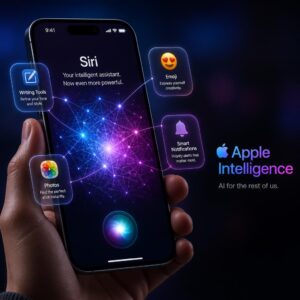
Apple Intelligence Capabilities on Both Models
Both the iPhone 17 and iPhone 17 Pro run iOS 19 with full Apple Intelligence support, including:
- Writing Tools (rewrite, summarize, proofread text anywhere)
- Image Playground and Image Wand
- Priority Notifications and Smart Reply
- Enhanced Siri with on-device and server-side AI processing
- ChatGPT integration (opt-in)
- Genmoji creation
- AI-powered Photo cleanup tools
The baseline Apple Intelligence experience is identical across both phones. Apple made sure of that when rolling out the feature set—you’re not paying extra for AI on the Pro.
Pro-Exclusive Software Features
Where the Pro pulls ahead:
- Final Cut Pro for iPad workflows with ProRes footage from the phone
- ProRes video recording enabled by the faster USB-C chip
- Advanced camera controls including exposure control gestures
- LiDAR-enhanced AR applications in supported apps
- Spatial video recording for Apple Vision Pro playback
If you use any of these features, the Pro’s software advantages are genuinely meaningful. If you don’t, they’re not.
Connectivity and Ports
USB-C Speeds: A Massive Difference
This is one of the most underreported differences between the two models:
| iPhone 17 | iPhone 17 Pro | |
|---|---|---|
| Port Type | USB-C | USB-C |
| USB Standard | USB 2.0 (480 Mbps) | USB 3.2 (up to 20 Gbps) |
| External Display | Limited | Full 4K external monitor support |
| ProRes Transfer Speed | Slow | Fast (near-instant for large files) |
That USB 2.0 vs USB 3.2 difference is enormous if you transfer large video files. Copying 10GB of ProRes footage from the standard iPhone 17 could take several minutes. On the Pro, it’s closer to 30 seconds.
For most users who back up wirelessly to iCloud, this will never matter. For content creators working with external drives or studio workflows? It’s a dealbreaker in favor of the Pro.
5G, Wi-Fi 7, and Satellite Connectivity
Both phones support:
- 5G Sub-6GHz and mmWave connectivity
- Wi-Fi 7 (802.11be) for ultra-fast local network speeds
- Bluetooth 5.3
- Emergency SOS via satellite and Roadside Assistance via satellite
Zero difference here. Apple democratized satellite connectivity across the full lineup, which is genuinely impressive.
Pricing Breakdown: What You’re Actually Paying For
iPhone 17 Price Tiers (Estimated)
| Storage | Price |
|---|---|
| 128GB | $799 |
| 256GB | $899 |
| 512GB | $999 |
iPhone 17 Pro Price Tiers (Estimated)
| Storage | Price |
|---|---|
| 256GB | $999 |
| 512GB | $1,099 |
| 1TB | $1,299 |
Real Cost of Ownership Over 3 Years
When you factor in carrier trade-in deals, AppleCare+ pricing ($9.99/month for either model), and resale value (Pro models typically hold value ~10–15% better over 36 months), the actual ownership cost delta between these two phones narrows considerably.
Running the numbers on a 36-month installment plan with trade-in, you’re often looking at a $6–$10 per month real-world difference. That framing changes how many people perceive the “premium” of the Pro.
iPhone 17 vs iPhone 17 Pro: Side-by-Side Comparison Table
| Feature | iPhone 17 | iPhone 17 Pro |
|---|---|---|
| Starting Price | $799 | $999 |
| Frame Material | Aluminum | Titanium |
| Display | 6.1″ OLED | 6.3″ OLED |
| Refresh Rate | 60Hz | 1–120Hz ProMotion |
| Always-On Display | ❌ | ✅ |
| Main Camera | 48MP | 48MP Fusion |
| Telephoto | ❌ | ✅ 5x optical zoom |
| Front Camera | 12MP | 24MP |
| LiDAR Scanner | ❌ | ✅ |
| ProRes Video | ❌ | ✅ |
| Chip | A18 | A18 Pro |
| GPU Cores | 5-core | 6-core |
| RAM | 8GB | 8GB |
| Base Storage | 128GB | 256GB |
| Max Storage | 512GB | 1TB |
| USB Standard | USB 2.0 | USB 3.2 |
| Battery Life | ~22 hrs video | ~23 hrs video |
| MagSafe Speed | 25W | 25W |
| Apple Intelligence | ✅ | ✅ |
| Satellite Connectivity | ✅ | ✅ |
| Wi-Fi 7 | ✅ | ✅ |
Who Should Buy the iPhone 17?
The base iPhone 17 is the right call if:
- You don’t shoot a lot of photos or video and your primary use is communication, social media, and media consumption
- You’re upgrading from an iPhone 12 or older—you’ll feel a massive performance leap from the A18 chip regardless of Pro status
- Budget matters—$200 is $200, and that money could go toward a case, AirPods, or an Apple Watch
- You want a lighter, slightly smaller phone for comfortable one-handed use
- You’re a student or first iPhone user who doesn’t need professional-grade camera tools
- You use wireless iCloud backup and don’t care about USB 3.0 transfer speeds
The iPhone 17 is not a compromise phone. It’s an excellent smartphone that outperforms most Android flagships in its class. Calling it “the lesser iPhone” does it a disservice.
Who Should Buy the iPhone 17 Pro?
The iPhone 17 Pro makes sense if:
- Photography is important to you—the telephoto lens alone is worth the price difference for anyone who regularly shoots events, travel, portraits, or nature
- You create video content for YouTube, TikTok, client work, or personal projects—ProRes and 4K 120fps are legitimate creative tools
- You’re a gamer who plays GPU-intensive titles and wants the best mobile gaming performance Apple offers
- You want 120Hz ProMotion—if you’ve used it before, you know you can’t go back
- You work with large files and need USB 3.2 speeds for professional workflows
- You want the absolute best iPhone Apple makes—no compromises, full stop
- You’re a power user who will genuinely push the phone to its limits
Expert Verdict: Is the Upgrade Worth the Money?
Here’s the honest take: for roughly 60% of iPhone buyers, the standard iPhone 17 is the right choice.
That might surprise you coming from a tech publication. But the data on how people actually use their smartphones consistently shows that the majority of users prioritize screen quality, speed, and camera for casual shooting—areas where the iPhone 17 performs brilliantly.
The Pro’s advantages are real, meaningful, and impressive. But they’re designed for a specific type of user. If you’re a content creator, mobile photographer, or power user who maxes out your phone’s capabilities daily, the Pro justifies every dollar of its premium.
If you’re primarily texting, streaming, scrolling, and snapping occasional photos—the $200 difference is better spent elsewhere.
One piece of advice: visit an Apple Store and pick up both phones. The titanium frame, the 120Hz display, and the camera heft will either speak to you immediately or they won’t. Trust that instinct.
FAQs: iPhone 17 vs iPhone 17 Pro
1. Is the iPhone 17 Pro camera worth the extra money for casual photographers?
For truly casual photography—birthday party shots, food photos, selfies, and vacation snaps—the iPhone 17’s 48MP main camera delivers excellent results. The gap becomes meaningful when you want to zoom in without losing quality (no telephoto on the base model), shoot in very low light (the Pro’s sensor and LiDAR help), or record professional-quality video. If photography is occasional and casual, save the money. If it’s a regular hobby or creative outlet, the Pro’s camera system will make you genuinely better at it.
2. Does the iPhone 17 have 120Hz display?
No. The standard iPhone 17 uses a 60Hz OLED display. The 120Hz ProMotion adaptive refresh rate is exclusive to the iPhone 17 Pro and iPhone 17 Pro Max. This is one of the most noticeable real-world differences between the two phones, particularly when scrolling, gaming, or using animation-heavy apps.
3. What’s the actual performance difference between the A18 and A18 Pro chips?
In everyday tasks—messaging, browsing, streaming, social media—you will not feel any performance difference between the A18 and A18 Pro. Both chips are exceptionally fast. The A18 Pro’s additional GPU core becomes relevant in compute-heavy applications like GPU-intensive gaming with ray tracing enabled, 3D rendering, real-time video processing, and professional AI workloads. For most users, the A18 is more than enough power for a 3–4 year ownership cycle.
4. Can the iPhone 17 shoot ProRes video?
No. ProRes video recording is exclusive to the iPhone 17 Pro lineup. The base iPhone 17 records in HEVC and H.264 formats, which are high quality but not suitable for professional post-production workflows that require ProRes. If you edit video professionally or deliver footage to clients in raw formats, this is a decisive reason to choose the Pro.
5. Is the titanium frame on the iPhone 17 Pro actually stronger than aluminum?
Grade-5 titanium is stronger than aluminum by weight—meaning it provides superior structural rigidity at a lower mass-to-strength ratio. In practice, the titanium frame resists bending and deformation better than aluminum, and its surface doesn’t scuff as visibly. However, titanium won’t protect your screen or glass back from drops any better than aluminum—both phones need a case for real drop protection. The durability advantage of titanium is more about frame integrity and long-term build quality than drop survivability.
6. Do both iPhone 17 models support Apple Intelligence?
Yes. Apple made Apple Intelligence available on all iPhone 17 models that include 8GB of RAM. Both the standard iPhone 17 and the iPhone 17 Pro fully support all Apple Intelligence features including Writing Tools, Image Playground, enhanced Siri, Smart Reply, Genmoji, and Clean Up in Photos. There’s no Apple Intelligence advantage for choosing the Pro—it’s an equal playing field on AI features.
7. What’s the iPhone 17 Pro Max, and how does it compare to the Pro?
The iPhone 17 Pro Max is the largest and most premium model in the lineup. It features the same A18 Pro chip and camera system as the standard Pro, but adds a 6.9-inch display, a larger battery (Apple claims up to 33 hours of video playback), and a tetraprism periscope telephoto lens for enhanced optical zoom range. If you want the absolute best battery life and the largest screen Apple offers, the Pro Max is the answer—at a starting price of approximately $1,199.
8. Which iPhone 17 holds its resale value better?
Historically, Pro models retain resale value better than standard models over 24–36 months. Apple’s Pro lineup typically commands a 10–15% higher resale value at the 2-year mark on platforms like Swappa, Back Market, and Apple’s own certified refurbished store. If you upgrade every two years and factor in trade-in or resale value, the effective cost difference between the iPhone 17 and iPhone 17 Pro narrows by $80–$120, making the Pro an even more financially defensible choice for frequent upgraders.
9. Is the USB 2.0 speed on iPhone 17 a real problem?
For most users: no. If you back up and sync wirelessly via iCloud, the USB-C port’s data speed is almost irrelevant in daily use. The gap only becomes significant for professionals transferring large files—particularly ProRes video footage—between the phone and a computer or external storage. A 10GB ProRes file could take 3–4 minutes to transfer via USB 2.0 and under a minute via the Pro’s USB 3.2. If you work with large media files regularly, this is a meaningful quality-of-life difference.
10. Should I wait for the iPhone 18 instead of buying now?
If you currently use an iPhone 14 or newer and your phone works fine, waiting for iPhone 18 (expected September 2026) is a reasonable approach—you’ll get another generation of camera, chip, and display improvements. However, if you’re on an iPhone 12 or older, cracked screen, struggling battery, or simply feeling held back by your current phone, the iPhone 17 lineup represents a significant generational leap worth making now. Waiting for the next iPhone is an endless game—there’s always something better on the horizon.
Published by CyberTechNerd.com | Mobile Technology | Last Updated: 2025
Disclaimer: Pricing and specifications reflect pre-release information and official Apple announcements available at the time of writing. Confirm current pricing at Apple.com before purchase. Affiliate links in this article may earn CyberTechNerd.com a commission at no additional cost to you.